Home › Minecraft › Minecraft Wildflowers: Where to Find Them and All Uses
Minecraft Wildflowers: Where to Find Them and All Uses
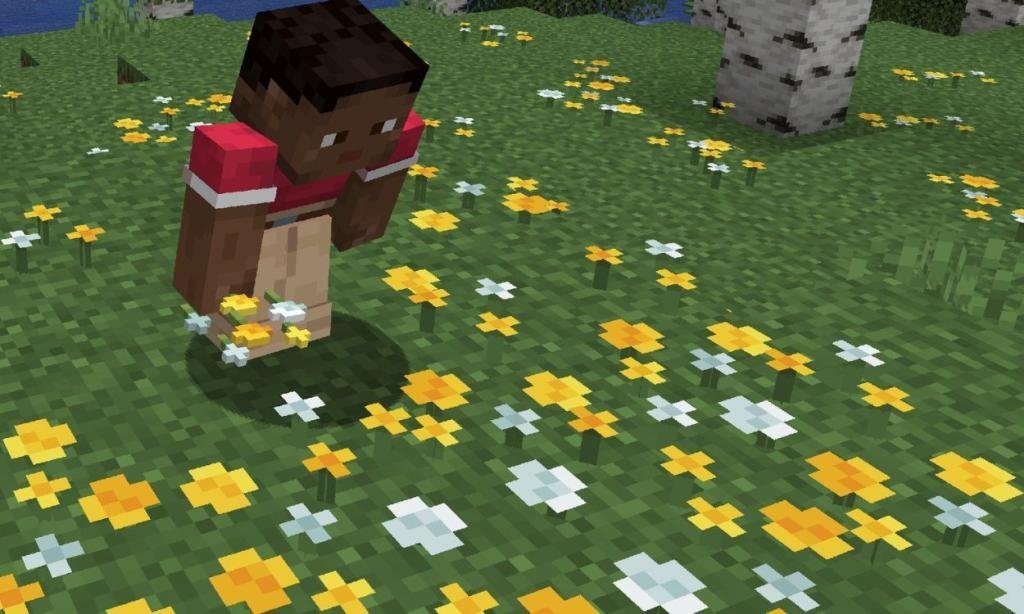
Wildflowers are the ground-hugging flower of the Spring to Life drop (1.21.5). Instead of standing on a tall stem like a tulip or daisy, they spread flat across the grass in patches of yellow and white, a little like cherry petals scattered on the ground. That flat profile makes them one of the most natural-looking decorations in the game.
Where to Find Wildflowers
Wildflowers are native to just three biomes:
- Birch Forest
- Old Growth Birch Forest
- Meadow
They break instantly with your hand or any tool, so harvesting a patch takes seconds. If you are exploring a birch forest anyway, it is worth filling a few inventory slots — you will want plenty once you start decorating.
Four Flowers on One Block
Wildflowers behave differently from every older flower. A single wildflower only covers one quarter of a block. You can place up to four on the same block, building up anything from a sparse sprinkle to a dense little carpet, and each flower keeps the direction you were facing when you placed it, so you can rotate them for a more natural, scattered look.
Multiplying them is easy. Bone meal applied to a block that already holds wildflowers adds more flowers to that same block. Be careful once a block is full, though: bonemealing a completely filled block makes the extra flowers break off. Annoying if you misclick — but actually a neat trick, because the broken flowers drop as items you can pick up and plant elsewhere, giving you a slow but working wildflower farm.
Uses for Wildflowers
Yellow Dye
Put a wildflower on the crafting grid and you get yellow dye, the same dye dandelions produce. Wildflower patches are far denser than dandelion spawns, so a meadow is one of the fastest places to stock up on yellow.
Bees and Bee Nests
Bees are attracted to wildflowers and will pollinate them, and you can breed bees by feeding wildflowers to them. There is a second, quieter benefit: if an oak, birch or cherry sapling grows into a tree with a flower within two blocks, the tree has a chance to generate with a bee nest attached. Planting your tree farm in a wildflower meadow is an easy way to farm nests passively.
Decoration
Honestly, decoration is the main event. Because they sit flat and mix two colors, wildflowers look brilliant sprinkled along paths, around ponds, under trees and across the floor of a cottage garden. Vary the density — one flower here, four there — and the ground stops looking like a repeating texture.
Getting the Density Right
The four-per-block system rewards a light touch. A full four flowers on every block reads as a solid carpet and can look artificial, so mix it up: four on some blocks, two on the next, a single flower on the one after that, then a bare gap. Fading the patch out at the edges — dense in the middle, sparse at the borders — mimics how the game generates them naturally and makes hand-placed meadows blend into wild ones. Because each flower also keeps your facing direction, rotating as you place breaks up the pattern even further. Two stacks of wildflowers and ten minutes of this is enough to transform the whole front garden of a cottage.
Small block, big payoff. If your builds ever feel like the grass is too plain, a pocketful of wildflowers fixes it in minutes.
Frequently asked questions
Where do wildflowers grow in Minecraft?
They generate in birch forests, old growth birch forests and meadows, in a mix of yellow and white, and can be picked up by breaking them with your hand.
How many wildflowers fit on one block?
Up to four. Each flower covers a quarter of the block, and each one keeps the orientation you faced when placing it.
What happens if you bone meal a full block of wildflowers?
The block cannot hold more, so the extra flowers break and drop as items. You can pick them up and plant them elsewhere, which makes it a simple way to multiply your supply.
What dye do wildflowers make?
Wildflowers craft into yellow dye, the same as dandelions — and their dense patches make them one of the fastest yellow dye sources.
More Minecraft guides
 Sea Pickles in Minecraft: How to Get, Farm and Use ThemUpdated 12 November 2026
 What Does Smite Do in Minecraft? Smite Enchantment GuideUpdated 12 November 2026
 How to Turn On Vibrant Visuals in MinecraftUpdated 12 November 2026
 What Do Horses Eat in Minecraft? Every Food and Its EffectsUpdated 12 November 2026
 All Wolf Variants in Minecraft and Where to Find ThemUpdated 12 November 2026