Home › Minecraft › Minecraft Trapped Chest: How to Make and Use It
Minecraft Trapped Chest: How to Make and Use It
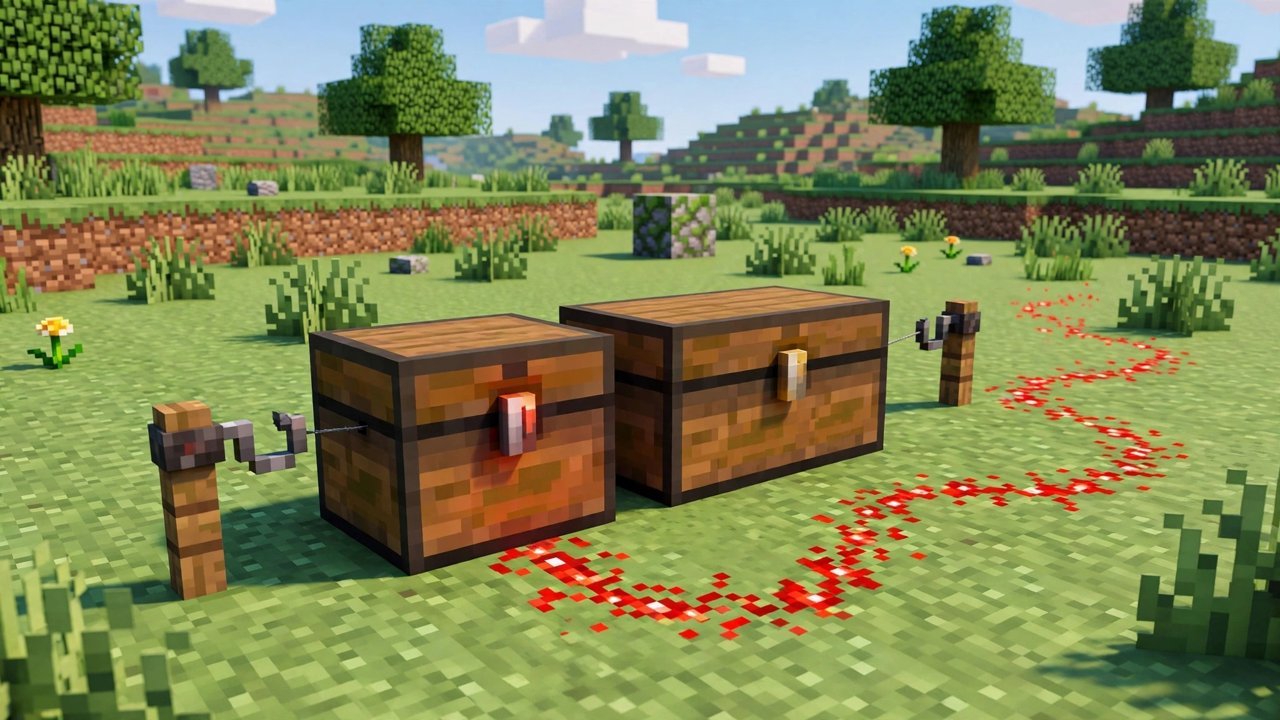
Every chest in Minecraft just sits there holding your stuff. The trapped chest looks identical, behaves identically as storage — and quietly betrays whoever opens it. It is the only storage block that talks to redstone, and that single property makes it the foundation of pranks, alarms, and a couple of surprisingly practical contraptions. Learn to spot the difference before your friends learn to use it on you.
What a Trapped Chest Actually Is
A trapped chest is a chest variant and a redstone component at the same time. Closed, it is indistinguishable at a glance. Look closely at the latch, though: a trapped chest has red pixels around the clasp where a normal chest is plain. That tiny detail is the only visible tell.
The moment someone opens it, the chest outputs a redstone signal to all four sides and downward. The strength is not fixed — it equals the number of players currently viewing the inventory, capped at 15. One curious friend produces a strength-1 whisper of power; a crowd around the chest produces a full blast. Mobs cannot open chests, so only players ever trigger it. Two trapped chests combine into a large trapped chest just like normal ones, and both halves transmit the signal while it is open.
Items Needed
- A regular chest — eight planks on a crafting table.
- A tripwire hook — one stick, one iron ingot, and one plank.
How to Craft It
This recipe is shapeless and tiny enough for your inventory's 2×2 grid — no crafting table required. Put the chest and the tripwire hook into the grid in any slots, in any arrangement, and the trapped chest appears in the result. That is genuinely the entire recipe; the tripwire hook is doing the redstone work, and the chest is along for storage.
Practical Uses
The safe trash can. Run a hopper underneath a trapped chest feeding a dropper aimed at lava or a cactus. While you are viewing the chest, its own signal locks the hopper, so nothing drains away while you are still deciding. Close the interface and the junk flushes. Accidentally tossed your good pickaxe in? While the chest is open, it is still sitting there waiting for you.
Alarms and counters. Because signal strength counts viewers, a comparator or a simple lamp circuit can tell you not just that someone opened your storage, but exactly how many someones are standing in your vault right now.
Trap Uses (Handle with Care)
The classic trap wires the chest's signal into TNT placed adjacent to or directly beneath it — the chest itself can power the block below it, igniting the charge when opened. TNT is easy to spot, though. The nastier evolution hides TNT minecarts under the floor: concealed, instant, and devastating in a minigame or server event where everyone knows the rules. On a friendly survival server, keep traps to pranks that embarrass rather than delete hours of someone's inventory — or accept the retaliation when it comes.
For storage alone, a trapped chest holds the standard 27 slots (54 for a large one), and like a normal chest, it cannot burn. As camouflage, decoration, or a redstone sensor disguised as furniture, it earns its place either way.
Frequently asked questions
Can a trapped chest burn?
No. Trapped chests, like regular chests, are completely fireproof and cannot be destroyed by burning.
Can anyone open a trapped chest?
By default, yes — anyone can open it, and opening it is what fires the signal. A chest with a modified Lock tag will only open for players holding a specific named item.
How strong is a trapped chest's redstone signal?
It matches the number of players viewing the inventory at that moment, from 1 up to a maximum of 15. It broadcasts to all four sides and downward.
How can you tell a trapped chest from a normal chest?
Check the latch. A trapped chest has red pixels around the clasp; a regular chest's latch is plain metal-colored.
More Minecraft guides
 Woodland Mansion in Minecraft: How to Find and Loot OneUpdated 12 November 2026
 Mineshafts in Minecraft: Loot, Cave Spiders and How to Find OneUpdated 12 November 2026
 Redstone Components in Minecraft: A Complete GuideUpdated 12 November 2026
 What Does Smite Do in Minecraft? Smite Enchantment GuideUpdated 12 November 2026
 All Wolf Variants in Minecraft and Where to Find ThemUpdated 12 November 2026