Home › Minecraft › Redstone Components in Minecraft: A Complete Guide
Redstone Components in Minecraft: A Complete Guide
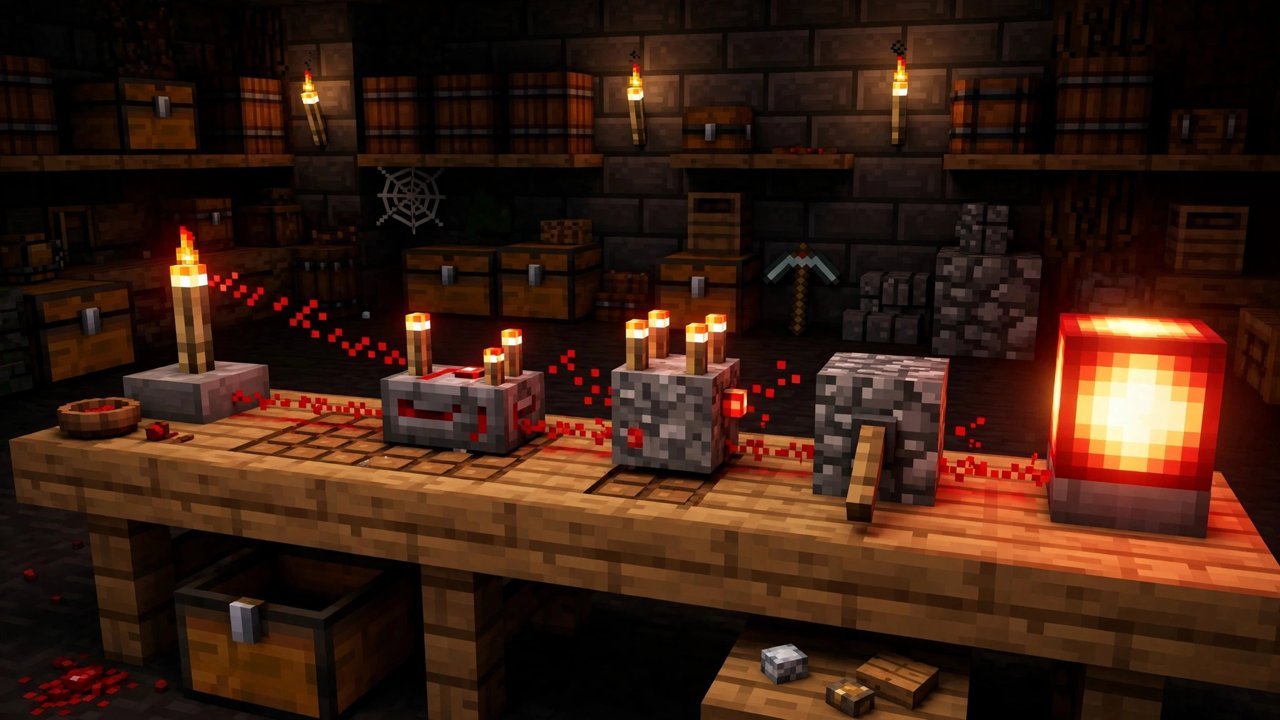
Redstone is Minecraft's electricity, and it intimidates new players mostly because nobody explains the parts in one place. In reality every component does one simple job, and they group neatly into three families: things that make power, things that move power around, and things that spend power doing work. Learn which family a block belongs to and you can read almost any machine.
The Golden Rule: Signal Strength
Redstone power is measured from 0 to 15. A fresh source outputs 15, and every block of redstone dust the signal travels through drops it by one, so after 15 blocks the line is dead. Nearly every redstone design problem is either this rule, or a repeater solving it.
Power Sources
- Redstone dust is the wire itself, and also an ingredient in half the other components. Mine redstone ore deep underground to get it.
- Lever (stick + cobblestone) — a simple on/off switch that stays where you leave it.
- Button (one plank or one stone) — sends a short pulse; wooden buttons stay pressed slightly longer than stone ones, and can be triggered by arrows.
- Pressure plates — fire when something stands on them. Wooden plates detect items too; iron and gold weighted plates output a strength based on how many entities pile on.
- Redstone torch (stick + dust) — a constant source that inverts: power the block it sits on and the torch turns off. That one trick powers countless circuits.
- Block of redstone (9 dust) — a solid, movable power source, handy inside piston machines.
- Daylight detector, sculk sensor, target block, detector rail and tripwire — the sense-based sources, reacting to light, vibration, projectile hits, passing minecarts and crossed strings respectively.
Transmission: Carrying and Thinking
Redstone repeaters (3 stone, 2 torches, 1 dust) do three jobs at once: they boost a fading signal back to full 15, they force the signal to travel in one direction only, and they add an adjustable delay of up to 0.4 seconds. Comparators (3 torches, 1 quartz, 3 stone) are the thinkers — they compare signal strengths, subtract one from another, and can read how full a chest, hopper or other container behind them is, outputting a strength from empty to full. Most automatic sorting and storage systems are really just comparators watching containers.
Mechanisms: Where Work Gets Done
- Pistons and sticky pistons push up to 12 blocks; the sticky version pulls one block back too.
- Dispensers use what they hold — shooting arrows, placing water, igniting TNT — while droppers merely spit items out untouched. That distinction runs half the farms in the game.
- Hoppers move items between containers and lock still when powered, forming the plumbing of every storage system.
- Observers watch the block in front of them and pulse whenever it changes — a crop growing, a machine firing — which makes them the eyes of automatic farms.
- Note blocks, redstone lamps and copper bulbs turn signals into music and light; the copper bulb even stays lit until pulsed again.
- The crafter (dropper, crafting table, 5 iron, 2 dust) crafts automatically whenever it receives a pulse — set a recipe in its grid and it will churn out torches, iron blocks or fireworks forever, as long as ingredients keep flowing in.
- Rails round it out: powered rails accelerate or brake minecarts, detector rails report them passing, and activator rails trigger whatever the cart is carrying.
Master the sources, the repeater and the observer, and the rest of redstone stops being magic and becomes plumbing.
Frequently asked questions
How far does a redstone signal travel?
Fifteen blocks. Signal strength starts at 15 and drops by one per block of redstone dust, reaching zero after 15 blocks. A repeater refreshes it back to full strength.
What is the difference between a dispenser and a dropper?
A dropper just ejects items as pickups. A dispenser actually uses them: it shoots arrows, places and picks up liquids with buckets, ignites TNT and more.
What does a redstone comparator do?
It compares or subtracts signal strengths, and it can read how full the container behind it is, outputting a signal from 1 (nearly empty) to 15 (full). This is the basis of item sorters.
What is the newest redstone component?
The crafter, added in 1.21. When it receives a redstone pulse it crafts whatever recipe is set in its grid using the items inside it, enabling fully automatic crafting.
More Minecraft guides
 Piglin Bartering in Minecraft: How to Trade with PiglinsUpdated 12 November 2026
 Minecraft Brewing Guide: All Potion RecipesUpdated 12 November 2026
 Minecraft Raids Explained: Bad Omen, Waves and Hero of the VillageUpdated 12 November 2026
 All Minecraft Villager Jobs ExplainedUpdated 12 November 2026
 Woodland Mansion in Minecraft: How to Find and Loot OneUpdated 12 November 2026