Home › Minecraft › How to Make Mud Bricks in Minecraft
How to Make Mud Bricks in Minecraft
Some building blocks shout for attention. Mud bricks do the opposite, and that is exactly their value. Their warm, earthy brown sits comfortably next to terracotta, jungle wood, granite and plain dirt, which makes them a go-to for cottages, desert towns, ruins and anything meant to look lived-in rather than polished. They are also one of the cheapest decorative blocks in the game once you know the two-step recipe behind them.
Step one: get mud
Mud generates in thick patches across mangrove swamp floors, where you can simply dig it up. You do not need to live near a swamp to have plenty, though. Use a glass bottle of water on an ordinary dirt block and the dirt converts straight into mud, right where it stands. That trick means any base with a water source and a dirt patch has an unlimited mud supply, and it works on one block at a time, exactly where you plan to build.
Step two: make packed mud
Mud bricks are not made from mud directly. First, combine one mud block with one wheat in a crafting grid, in any arrangement, to make one packed mud. Wheat is the only real cost in the whole chain, so a modest wheat patch beside your building site keeps production moving. Packed mud is a decent building block in its own right, smoother and paler than mud, and worth keeping a stack of for floors and paths.
Step three: craft the bricks
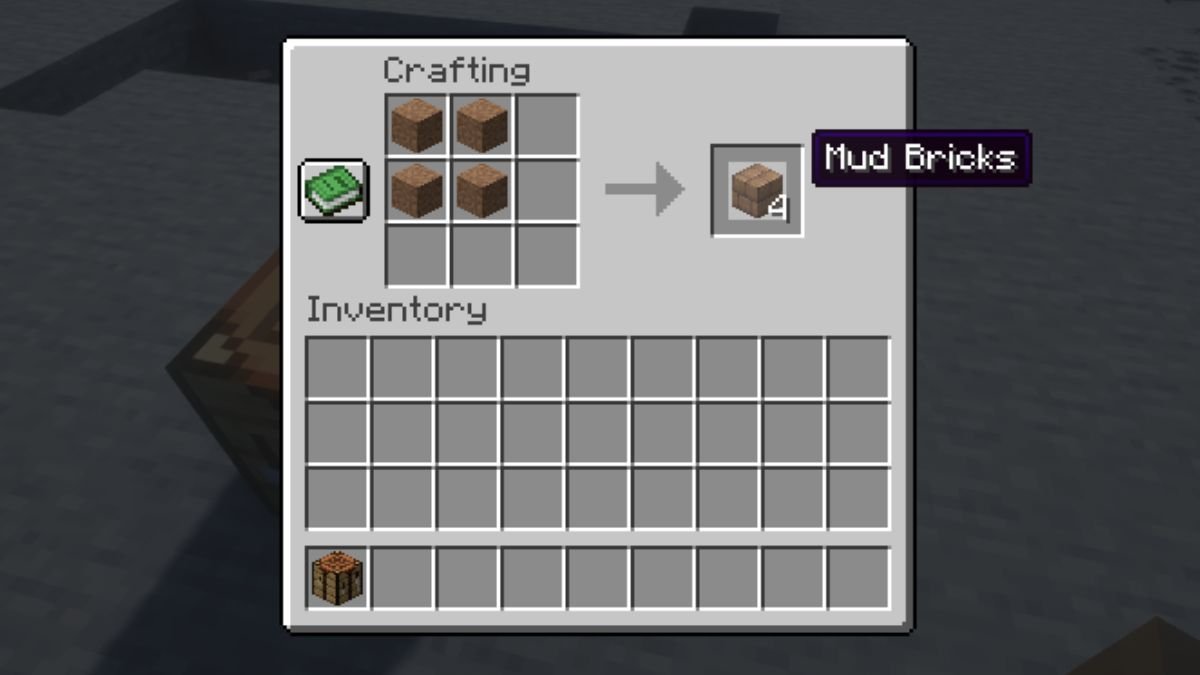
Place four packed mud in a 2 by 2 square in the crafting grid and you get four mud bricks. The recipe fits in your personal inventory grid, so no crafting table trip is needed, and a full stack of packed mud converts in seconds. That is the whole process: water on dirt, wheat in the grid, bricks out.
The explorer's shortcut: trail ruins
If you would rather dig your bricks up than make them, trail ruins are full of mud bricks and their variants, buried in the gravel and dirt of the structure. Mine them with a pickaxe. The amounts are unpredictable compared with crafting, but a single ruin usually yields a useful haul alongside its other loot, and it is a good source early on before your wheat farm exists.
Variants and building tips
Mud bricks come in slab, stair and wall variants. A stonecutter converts one block into stairs or slabs with no waste, which beats the crafting table recipes, and walls are crafted six at a time from two rows of three. Because the brick texture is busy, with deep mortar lines, a little goes a long way: use mud bricks for foundations, chimneys, borders and feature walls, then let calmer blocks like packed mud, stripped jungle wood or polished granite carry the big surfaces. For bulk production, a crafter block fed with mud and wheat can automate packed mud, and a second crafter can turn that straight into bricks while you build.
Colour pairings that work
Mud bricks reward restraint and good company. They look best in builds that lean into their colour: terracotta roofs, acacia or jungle wood beams, sandstone trims for desert work, and copper roofs whose green patina plays off the brown brickwork surprisingly well. Indoors, a mud brick fireplace or kitchen wall adds warmth without the heaviness of stone brick. If a wall of pure mud brick feels too patterned, break it every few blocks with packed mud pillars, which share the palette but calm the texture down.
Frequently asked questions
What is the recipe for mud bricks in Minecraft?
Four packed mud in a 2 by 2 crafting square makes four mud bricks. The recipe fits in your inventory grid, so you do not need a crafting table.
How do you make packed mud?
Combine one mud block and one wheat anywhere in a crafting grid. Mud comes from mangrove swamps, or by using a water bottle on a dirt block to convert it.
Where can you find mud bricks naturally?
Trail ruins generate with mud brick blocks and variants built into them. Excavate the structure and mine the bricks with a pickaxe.
Can mud bricks be automated?
Yes. Crafters can combine mud and wheat into packed mud and then packed mud into bricks, so a wheat supply plus a mud source can feed a fully automatic brick line.
More Minecraft guides
 Redstone Components in Minecraft: A Complete GuideUpdated 12 November 2026
 Respiration Enchantment in Minecraft: Breathe Longer UnderwaterUpdated 12 November 2026
 What Does Smite Do in Minecraft? Smite Enchantment GuideUpdated 12 November 2026
 What Do Horses Eat in Minecraft? Every Food and Its EffectsUpdated 12 November 2026
 All Wolf Variants in Minecraft and Where to Find ThemUpdated 12 November 2026