Home › Minecraft › How to Make an Item Sorter in Minecraft
How to Make an Item Sorter in Minecraft
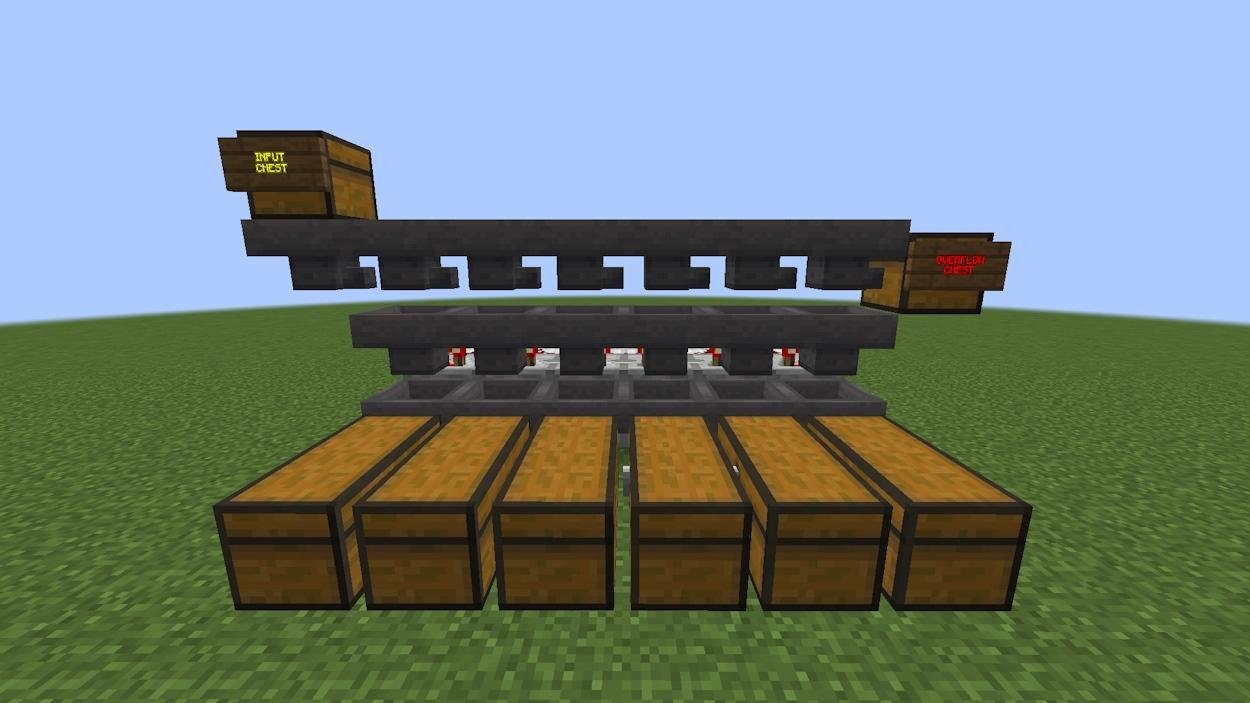
Every big farm ends the same way: a wall of chests stuffed with mixed drops and twenty minutes of digging whenever you need one specific thing. An item sorter fixes that permanently. It is a small redstone module — the classic design popularised by impulseSV — that lets exactly one type of item pass into its own chest and sends everything else on its way. Build one module and you have learned the whole system, because modules simply tile side by side.
What One Module Costs
- 1 chest (at least — you will want more for storage)
- 2 hoppers
- 1 redstone comparator
- 1 redstone repeater
- 1 redstone torch
- 3 redstone dust
- 4 cheap items renamed on an anvil (renamed dirt or cobblestone is classic)
- 41 of the item you want to filter, plus building blocks
One limit to know up front: this design works with items that stack to 64. Items that stack to 16, like ender pearls, need a modified design.
Building the Module
- Place a chest and push a hopper into its side. This bottom hopper is the gate: it only feeds the chest when the redstone unlocks it.
- Behind that hopper, dig a trench four blocks long and one block wide. Put a solid block at the far end, another block two spaces from the hopper, a redstone torch on the hopper-side block, and a repeater between the blocks facing the hopper.
- Cap the trench with three solid blocks running over the torch, the gap and the repeater, then lay your three redstone dust in a row on top.
- Place the comparator on the block above the torch, facing the dust line.
- Crouch and place the second hopper on top of the first, pointing into the comparator. Items will flow across the top of this hopper from module to module.
Loading the Filter
This is the step that makes the magic work. Open the top hopper and put one renamed filler item in each of the last four slots — one per slot, not a stack. Then put 41 of your chosen item in the first slot (with one more passing through as you test, the hopper settles at 41 in the slot plus the system's working item). The filler items matter: they guarantee no other item type can ever occupy those slots, and because renamed junk never flows through your storage system, they sit there forever.
How the Sorting Actually Works
The comparator constantly reads how full the top hopper is. At the resting load — 41 target items plus four fillers — its signal is just strong enough to reach the torch through the repeater and dust, which keeps the bottom hopper locked. When a matching item lands in the top hopper, the count rises, the signal strengthens, the torch switches off and the bottom hopper unlocks just long enough to drain the excess back down to the resting load, dropping your sorted items into the chest. Non-matching items cannot add to the first slot at all, so they simply ride the hopper line to the next module — or into a final overflow chest at the end of the row.
Expanding the System
Repeat the module once per item, feed the top hopper line with a water stream or a chain of hoppers from your farm or input chest, and end the line with an overflow chest for anything unfiltered. Stack extra chests and hoppers beneath each module for bulk storage. It is not a cheap build — iron for hoppers adds up fast — but the first time you walk up and grab exactly what you need in two seconds, it pays for itself.
Frequently asked questions
How does an item sorter work in Minecraft?
A comparator reads the filter hopper's contents. At the exact resting load of 41 target items plus four renamed fillers, the signal keeps the output hopper locked; any extra matching item strengthens the signal, unlocks the hopper briefly, and drains the excess into the chest.
Why do item sorters need renamed items?
The four renamed items occupy the last four hopper slots one each, so nothing else can ever fill them. That keeps the comparator's signal strength precise and stops the filter from overflowing into neighbouring modules.
Why does the filter hopper keep 41 items?
That quantity produces exactly the signal strength the circuit is tuned for. Fewer items would require more filler, which pushes the signal too high and can power adjacent redstone lines, breaking neighbouring modules.
Can an item sorter sort ender pearls or eggs?
Not this design. It is built for items that stack to 64; items stacking to 16 produce different signal strengths and need a modified filter.
More Minecraft guides
 All Minecraft Villager Jobs ExplainedUpdated 12 November 2026
 Woodland Mansion in Minecraft: How to Find and Loot OneUpdated 12 November 2026
 Mineshafts in Minecraft: Loot, Cave Spiders and How to Find OneUpdated 12 November 2026
 Redstone Components in Minecraft: A Complete GuideUpdated 12 November 2026
 All Wolf Variants in Minecraft and Where to Find ThemUpdated 12 November 2026