Home › Minecraft › How to Make a Froglight in Minecraft (All 3 Colours)
How to Make a Froglight in Minecraft (All 3 Colours)
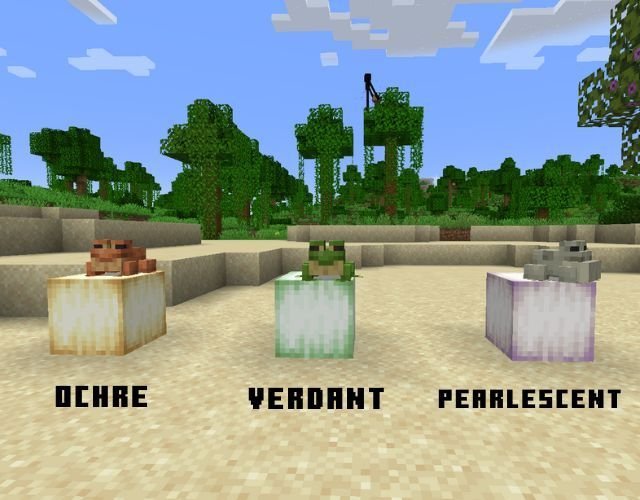
Froglights are Minecraft's prettiest light source and the only one produced by an animal's lunch. There is no crafting recipe. Instead, a frog that swallows a small magma cube drops a glowing block, and which of the three colours you get depends entirely on which frog did the eating. Collecting the full set takes a bit of travel, but each individual froglight takes about a minute once you are set up.
The three variants
| Froglight | Colour | Dropped by |
|---|---|---|
| Ochre | Orange-yellow | Temperate frog (orange) |
| Verdant | Green | Cold frog (green) |
| Pearlescent | Purple-pink | Warm frog (white) |
A frog's variant is fixed by the temperature of the biome where it grew up from a tadpole, not where you find it. Temperate frogs are the swamp standard. Warm frogs come from warm places like mangrove swamps. Cold frogs come from snowy and frozen biomes. All three froglights emit light level 15, the maximum in the game, matching glowstone and lanterns, and they do not melt snow or ice any faster for it. They are also immune to fire and lava, which makes them a safe choice for Nether bases.
What you need
- A frog of the variant whose colour you want
- Small magma cubes, found in the Nether
- A lead to move the frog, or a breeding setup near the cubes
- A sword for splitting large magma cubes down to size
How to get a froglight
- Find your frog. Regular swamps hold temperate frogs and mangrove swamps hold warm ones. For a cold frog, raise tadpoles in a cold biome or lead a frog there and breed.
- Bring the frog to magma cubes. Magma cubes hop around basalt deltas, Nether fortresses and bastions. Either lead the frog through a portal to a safe, enclosed patch of a basalt delta, or fence off an area and bring the cubes to the frog's side of the portal.
- Kill the large magma cubes you find; each splits into smaller ones, and those split again into the smallest size. Frogs only eat the smallest cubes, so keep splitting until only minis remain.
- Let the frog do the rest. It will snap up small magma cubes on its own, and each one eaten drops a froglight of the frog's colour at its feet.
Turning it into a farm
Once you have done it by hand, the farm version is obvious: a fenced pen in or beside a basalt delta, a resident frog, and a steady supply of magma cubes wandering in. Players often build a small chamber where magma cubes spawn, get funneled to the frogs, and the froglights are collected from the floor. Even without automation, ten minutes in a basalt delta with a leashed frog yields a stack of lights. Use them anywhere you would use glowstone: paths, ceilings, underwater builds, and anywhere you want colour-coded lighting, green for a slime area, purple for a storage vault, warm ochre for the kitchen.
Raising the frog you need
If the right frog variant does not live anywhere convenient, raise it yourself. Scoop tadpoles into a bucket after breeding frogs with slimeballs, carry the bucket to a biome of the temperature you want, and let the tadpoles grow up there in a safe pond; the adults take the variant of that biome, whatever their parents were. A fenced pond beside a portal makes this painless: tadpoles in, frogs out, and the Nether trip for their first magma cube is only a few blocks long.
Frequently asked questions
Can you craft a froglight in Minecraft?
No, there is no recipe. Froglights are dropped by frogs when they eat small magma cubes, one froglight per cube eaten.
How do you get all three froglight colours?
Use three different frogs. Temperate (orange) frogs drop ochre, cold (green) frogs drop verdant, and warm (white) frogs drop pearlescent froglights. A frog's type is set by the biome temperature where it grew from a tadpole.
How bright is a froglight?
Light level 15, the highest in the game, equal to glowstone, lanterns and fire. It is also fire and lava proof, so it is safe to build with in the Nether.
Where do magma cubes spawn?
In the Nether, most reliably in basalt deltas, and also in Nether fortresses and bastion remnants. Hit large ones to split them into the small cubes that frogs will eat.
More Minecraft guides
 Redstone Components in Minecraft: A Complete GuideUpdated 12 November 2026
 Respiration Enchantment in Minecraft: Breathe Longer UnderwaterUpdated 12 November 2026
 What Does Smite Do in Minecraft? Smite Enchantment GuideUpdated 12 November 2026
 What Do Horses Eat in Minecraft? Every Food and Its EffectsUpdated 12 November 2026
 All Wolf Variants in Minecraft and Where to Find ThemUpdated 12 November 2026