Home › Minecraft › How to Make a Cauldron in Minecraft
How to Make a Cauldron in Minecraft
The cauldron looks like a simple iron pot, but it is one of the most quietly versatile blocks in Minecraft. It stores water where water should not survive, holds lava safely in a wooden house, washes dye off banners and leather armor, and gives leatherworker villagers their job. If you have seven iron ingots going spare, here is why a cauldron deserves them.
What You Need to Make a Cauldron
Just one ingredient, seven times: 7 iron ingots, plus a crafting table. Smelt raw iron in a furnace or blast furnace to get ingots, or loot them from structure chests. Iron-hungry bases usually solve the supply permanently with a small iron farm, but for a single cauldron a short caving trip is more than enough.
The Cauldron Crafting Recipe
- Open the crafting table.
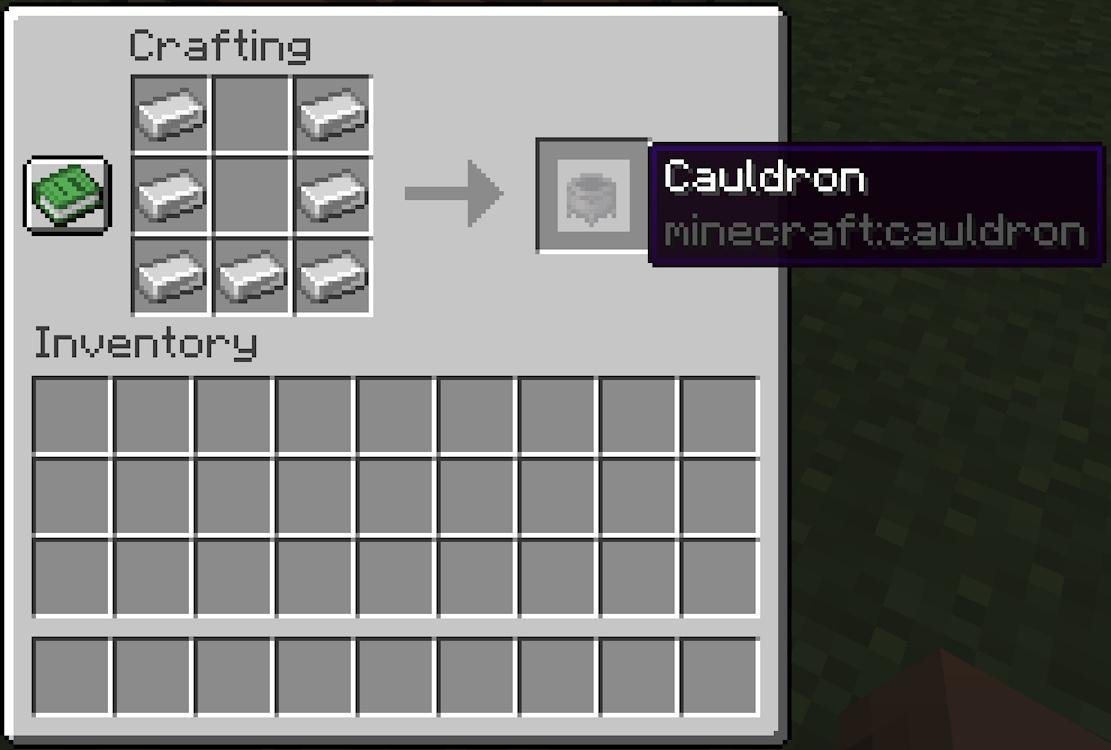
- Fill the entire bottom row with three iron ingots.
- Fill the left column and the right column with the remaining ingots.
- The grid should look like the letter U — take the cauldron from the result slot.
Leave the top-middle and centre slots empty; that hollow is the whole point of the shape. A crafter block can produce cauldrons automatically with a redstone pulse if you ever need them in industrial quantities.
Where Cauldrons Generate for Free
Seven ingots is not nothing in the early game, so it is worth knowing the world hands cauldrons out. Check these spots before you craft:
- Witch huts in swamps, which always hold one (sometimes with a potion inside)
- Igloo basements in snowy plains, snowy taiga and snowy slopes
- Woodland mansions, scattered through their many rooms
- Leatherworker houses in villages — though not every village generates one
- Trail ruins, buried with the rest of the archaeology
What a Cauldron Actually Does
Fill a cauldron with a bucket and its talents start showing. It holds three bottles' worth of water, which makes it a compact water source for brewing areas. In the Nether, where open water evaporates instantly, a filled cauldron is one of the only ways to have water on hand — and stepping into one even puts out fire, a genuine lifesaver. Rain slowly fills an empty cauldron left outdoors, and a dripstone stalactite dripping into one fills it with water — or lava, if lava hangs above the dripstone, giving you a slow but infinite lava source.
The cauldron is also the game's washing machine. Use dyed leather armor or a dyed banner on a water cauldron and the colour rinses out, one shade level at a time. Bedrock players get extra tricks: cauldrons there can hold potions and let you tip arrows, and dye can be mixed into the water itself to colour leather armor in blends Java cannot produce. Finally, an unemployed villager who claims a cauldron becomes a leatherworker, and a cauldron under a comparator gives redstone players a handy signal based on how full it is.
One cauldron by the door for rainy-day water, one in the Nether as a fire extinguisher, one in the dye workshop — few blocks earn their iron three times over like this.
Frequently asked questions
Can you find a cauldron in every village?
No. Cauldrons generate in leatherworker houses, and whether a village has one of those houses is random — some villages have two or three, others none.
How do you make a water cauldron?
You only ever craft the empty cauldron. Fill it afterwards with a water bucket, leave it out in the rain, or set dripstone dripping into it.
How much water does a cauldron hold?
Three glass bottles' worth. Each bottle you fill lowers the water level by one third.
What villager job does a cauldron create?
A leatherworker. An unemployed villager who claims a cauldron takes that profession and trades in leather goods.
More Minecraft guides
 All Minecraft Villager Jobs ExplainedUpdated 12 November 2026
 Woodland Mansion in Minecraft: How to Find and Loot OneUpdated 12 November 2026
 Mineshafts in Minecraft: Loot, Cave Spiders and How to Find OneUpdated 12 November 2026
 Redstone Components in Minecraft: A Complete GuideUpdated 12 November 2026
 All Wolf Variants in Minecraft and Where to Find ThemUpdated 12 November 2026