Home › Minecraft › How to Hatch Turtle Eggs in Minecraft (and Keep Them Safe)
How to Hatch Turtle Eggs in Minecraft (and Keep Them Safe)
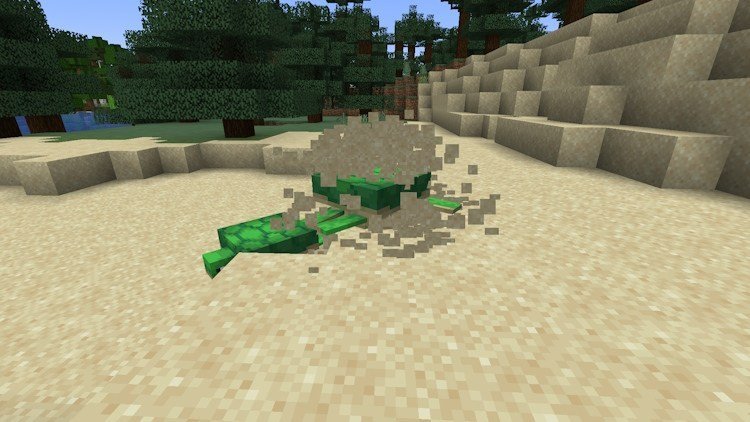
Turtle eggs are easy to overlook, but they sit behind one of Minecraft's most useful items, the turtle shell helmet, and one of its best farm tricks. They are also fragile in ways that catch new players out, so here is the whole process from breeding to hatching.
Getting Turtle Eggs
Eggs never generate on their own. Feed seagrass to two adult turtles on a beach and one of them becomes pregnant, waddles back to the beach where it spawned, digs in the sand for a few seconds and lays a cluster of one to four eggs. That home-beach loyalty matters: a turtle always returns to its birthplace to lay, no matter how far away it has wandered.
If you want the eggs somewhere else, you must move them with a Silk Touch tool. Break them any other way and they are destroyed. And watch your feet: walking or falling onto eggs cracks them too.
How Hatching Works
Eggs only make progress on sand or red sand. On any other block they sit there forever, which is handy for decoration but useless for breeding. A valid egg passes through three visible cracking stages. On average the full process takes around seven in-game days, but almost all cracking happens during a window at night, so eggs kept through four or five nights usually hatch. All eggs sharing one block crack together, so clusters hatch in sync.
One distance rule surprises people: eggs make no progress at all if every player is more than 128 blocks away. Build your hatchery near your base, not on a distant beach you visit once a week.
Protecting the Eggs
Here is the babysitting part. Zombies, zombie villagers, husks, drowned and zombified piglins actively pathfind to turtle eggs and trample them on purpose. If there are two air blocks above an egg, they will find a way in. A simple fence ring around the nest stops them, since they cannot jump it while targeting the eggs.
The danger does not end at hatching. Baby turtles are hunted by most undead, plus skeletons, strays, wolves, ocelots, foxes and more, so keep that fence up until the babies reach the water. When a baby finally grows up, about one Minecraft day later, or much sooner if you feed it seagrass, it drops a scute. Five scutes craft the turtle shell helmet, which grants ten extra seconds of underwater breathing and can be brewed into the Potion of the Turtle Master.
Eggs as a Farm Tool
That zombie obsession with eggs is a feature, not a bug. Because undead make a beeline for eggs, farm builders use them as bait: zombified piglins in the Nether will charge at eggs placed over a drop pit, which is the engine of most efficient gold farms. Egg clusters also make convincing kitchen and garden decorations, precisely because they never hatch off sand.
A final patience tip: eggs crack in stages, and a stage only advances when a random tick lands on the egg during that night window, so a stretch of bad luck is normal. If several nights pass with no new cracks, check the basics again: sand underneath, no solid block smothering the eggs from above, and someone actually standing within range while the night passes. Sleeping through the night in a bed nearby still counts as being present, as long as you are close enough when darkness falls.
Frequently asked questions
Why won't my turtle eggs hatch?
They are probably not on sand or red sand, or you are standing more than 128 blocks away. Eggs only progress on sand, and only while a player is nearby.
Do turtle eggs need sunlight to hatch?
No, the opposite. Cracking happens overwhelmingly at night, so keeping the area loaded through several nights speeds things up.
How do I move turtle eggs without breaking them?
Mine them with a Silk Touch tool. Any other tool destroys the egg, and stepping on eggs breaks them too.
What do you get from hatching turtles?
When a baby turtle grows into an adult it drops a scute. Five scutes craft a turtle shell helmet that gives bonus underwater breathing time.
More Minecraft guides
 Redstone Components in Minecraft: A Complete GuideUpdated 12 November 2026
 Respiration Enchantment in Minecraft: Breathe Longer UnderwaterUpdated 12 November 2026
 What Does Smite Do in Minecraft? Smite Enchantment GuideUpdated 12 November 2026
 What Do Horses Eat in Minecraft? Every Food and Its EffectsUpdated 12 November 2026
 All Wolf Variants in Minecraft and Where to Find ThemUpdated 12 November 2026