Home › Minecraft › How to Grow Cocoa Beans in Minecraft
How to Grow Cocoa Beans in Minecraft
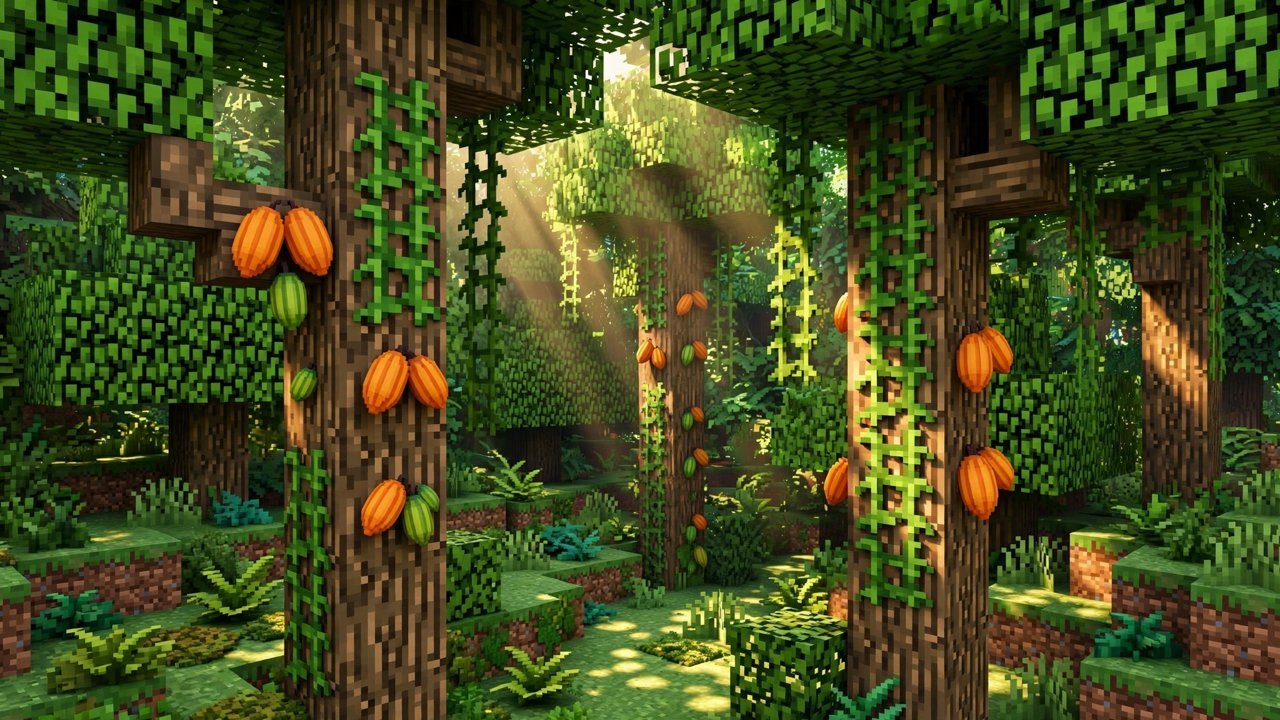
Almost every crop in Minecraft follows the same logic: till dirt, plant seed, wait. Cocoa beans break all of it. You cannot plant them in farmland, you cannot plant them on grass, and you cannot plant them on just any tree. They belong to the jungle, and once you understand that one rule, they become one of the easiest crops in the game to farm in bulk.
Where to Find Cocoa Beans First
On Java Edition, cocoa beans come from one place: cocoa pods growing on the smaller jungle trees in jungle, bamboo jungle, and sparse jungle biomes. The pods hang on the trunks at eye level and stand out clearly once you know the shape — a lumpy oval that changes color as it matures.
Pods grow through three stages. The small green pod and the medium pod each drop just one cocoa bean when broken, while the third, largest stage — plump and deep brown-orange — drops three. An axe breaks them fastest, though any tool or even your fist works. Harvesting early is the classic beginner waste here: patience literally triples your yield.
Bedrock players get extra sources on top of the jungle pods. Cocoa beans can turn up in bonus chests, come from fishing inside jungle biomes, and occasionally appear in a wandering trader's offers. Java players, for better or worse, walk to the jungle like everyone else.
How to Plant and Grow Cocoa Beans
With beans in hand, the planting rule is absolute: cocoa beans can only be placed on jungle wood. That means jungle logs and jungle wood blocks, stripped or unstripped — notably, jungle planks do not count. Use the bean on the side of the log, and a small green pod appears, attached and ready to grow.
From there, growing takes care of itself:
- Stage one — a small, pale green pod.
- Stage two — a medium pod, yellowing as it swells.
- Stage three — a large brown pod, fully ripe and ready.
Time moves the pods between stages, but bone meal hurries things along — a single application advances the pod by one stage, assuming it takes effect. A simple farm design is just rows of jungle logs with space around them, pods on every face, and a walkway down the middle. More advanced setups use pistons to knock ripe pods off the logs for collection, turning harvest into a button press.
What Cocoa Beans Are Used For
Cocoa beans exist mainly to make brown dye. On Java, place a bean in a crafting grid and it converts into one brown dye, ready for wool, banners, beds, and everything else dye touches. Bedrock skips the conversion step entirely — cocoa beans behave as brown dye directly in recipes there. Brown is one of the trickiest dye colors to source in bulk, which is precisely why a cocoa farm earns its keep.
Their other recipe is a humble one: cocoa beans combine with wheat to bake cookies, two per craft — weak as food, charming as a gift. And if you ever find yourself drowning in beans, they compost reliably, raising a composter's level with a 65% success chance per bean.
Frequently asked questions
Can you farm cocoa beans in Minecraft?
Yes. Rows of jungle logs with pods on each face make a simple farm, and piston-based designs can knock ripe pods loose for fast harvesting. Bone meal speeds each pod's growth.
Why won't my cocoa beans plant?
They only attach to the side of jungle logs or jungle wood blocks. Dirt, farmland, other wood types, and jungle planks all refuse them.
How many beans does one pod give?
Small and medium pods drop one bean each. A fully grown third-stage pod drops three, so waiting for pods to ripen fully triples your harvest.
What are cocoa beans for?
Mainly brown dye — converted in the crafting grid on Java, used directly as dye on Bedrock. They also bake into cookies with wheat and can be composted.
More Minecraft guides
 Woodland Mansion in Minecraft: How to Find and Loot OneUpdated 12 November 2026
 Mineshafts in Minecraft: Loot, Cave Spiders and How to Find OneUpdated 12 November 2026
 Redstone Components in Minecraft: A Complete GuideUpdated 12 November 2026
 What Does Smite Do in Minecraft? Smite Enchantment GuideUpdated 12 November 2026
 All Wolf Variants in Minecraft and Where to Find ThemUpdated 12 November 2026