Home › Minecraft › How to Find and Use Bamboo in Minecraft
How to Find and Use Bamboo in Minecraft
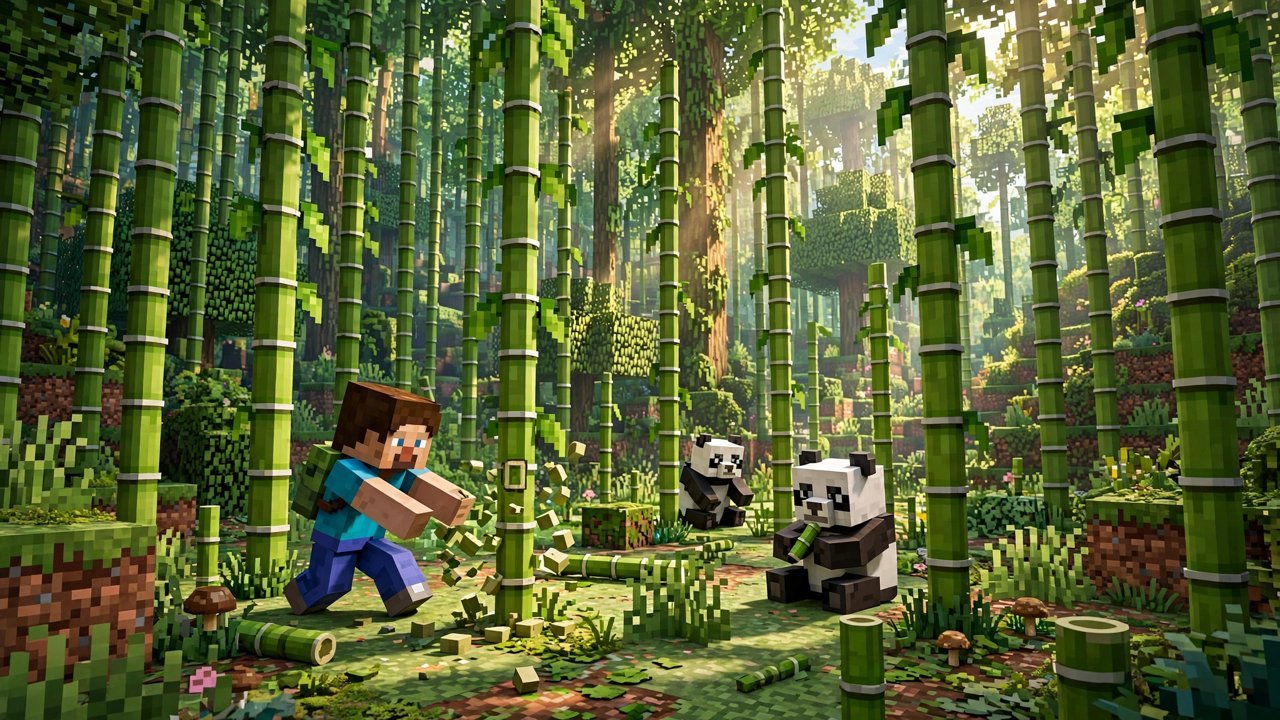
Bamboo is one of those resources that is annoying to find once and impossible to run out of ever after. One stalk planted next to your base becomes a self-renewing forest, and between bamboo wood, scaffolding, and panda food, you will use all of it. Here is where to find your first stalk, how to grow it well, and what it is good for.
Where to Find Bamboo
Jungle biomes
In the wild, bamboo generates only in jungles. Regular jungles scatter individual stalks through the undergrowth, while bamboo jungles are wall-to-wall with it. The one exception is the sparse jungle, which generates none. Any tool breaks bamboo instantly, though slicing it with a sword is fastest; just note the sword takes double durability damage on bamboo.
Fishing and chests
Casting a line in a jungle can reel in bamboo as a junk item, a niche trick that matters on Skyblock-style maps where jungles may not exist. Luck of the Sea actually lowers your bamboo odds, since it reduces junk catches. Jungle temple and shipwreck chests can also contain bamboo.
Pandas
The unkind option: killing a panda drops one bamboo on Java and up to two on Bedrock, with Looting helping only on Bedrock. Almost nobody needs bamboo this badly.
How to Grow Bamboo
Unlike sugar cane, bamboo ignores water completely. Right-click it onto dirt and grass variants, gravel, sand, or mud (moss works too on Java) and it plants as a small shoot. The only real requirement is light: the top of the stalk needs light level 9 or higher to keep growing, so open sky works best.
A stalk tops out at 12-16 blocks tall and grows quickly on its own; bone meal hurries it along if you are in a rush. To harvest, break the second block from the ground. Everything above shatters into items at once, and the shoot left behind regrows the whole column. Placing string above a stalk caps its height, which is handy for tidy decorative rows, and a stalk in a flower pot makes a neat indoor plant.
Uses of Bamboo
- Bamboo wood: nine bamboo crafts a block of bamboo, the log of the bamboo wood set. From there you get planks, mosaic blocks, doors, signs, rafts, and the rest of a full pale-green building palette.
- Scaffolding: bamboo plus string makes the best temporary building platform in the game.
- Sticks: two bamboo make one stick, a poor rate but useful in a pinch.
- Fuel: four bamboo smelt one item, weak per piece but infinite in quantity.
- Panda breeding: pandas only enter love mode when bamboo is growing nearby, and baby pandas can be fed bamboo to grow faster.
One disappointment to know in advance: bamboo cannot go in a composter at all. Everything else about it is generous, though. Plant a handful of stalks on day one and by the time you are building with bamboo wood, the patch will have quietly outgrown your needs.
Scaling Up: A Simple Bamboo Farm
Once hand-harvesting stops keeping up, bamboo is one of the easiest crops to automate. A row of bamboo behind a line of pistons, watched by an observer that detects growth, can shear the stalks at mid-height and let hoppers gather the fall. Even without redstone, planting bamboo along both banks of a river near your base gives you a harvest you can collect on a boat ride. Pair the farm with a crafter and it can feed you finished bamboo blocks while you are busy elsewhere, which is when bamboo really earns its keep as a building material.
Frequently asked questions
Why won't my bamboo grow in Minecraft?
The top of the stalk needs light level 9 or more. Bamboo stalled under a roof or dense tree canopy usually starts growing again once it gets open sky.
Does bamboo need water to grow?
No. Unlike sugar cane, bamboo grows on dry land with no water nearby. It only needs a valid block to plant on and enough light.
Can you turn bamboo blocks back into bamboo?
No. Crafting bamboo into a block of bamboo is a one-way process, so keep some raw stalks in reserve.
Can bamboo be composted?
No, bamboo is one of the few plant items the composter refuses entirely.
More Minecraft guides
 Redstone Components in Minecraft: A Complete GuideUpdated 12 November 2026
 Respiration Enchantment in Minecraft: Breathe Longer UnderwaterUpdated 12 November 2026
 What Does Smite Do in Minecraft? Smite Enchantment GuideUpdated 12 November 2026
 What Do Horses Eat in Minecraft? Every Food and Its EffectsUpdated 12 November 2026
 All Wolf Variants in Minecraft and Where to Find ThemUpdated 12 November 2026