Home › Minecraft › How to Breed Villagers in Minecraft
How to Breed Villagers in Minecraft
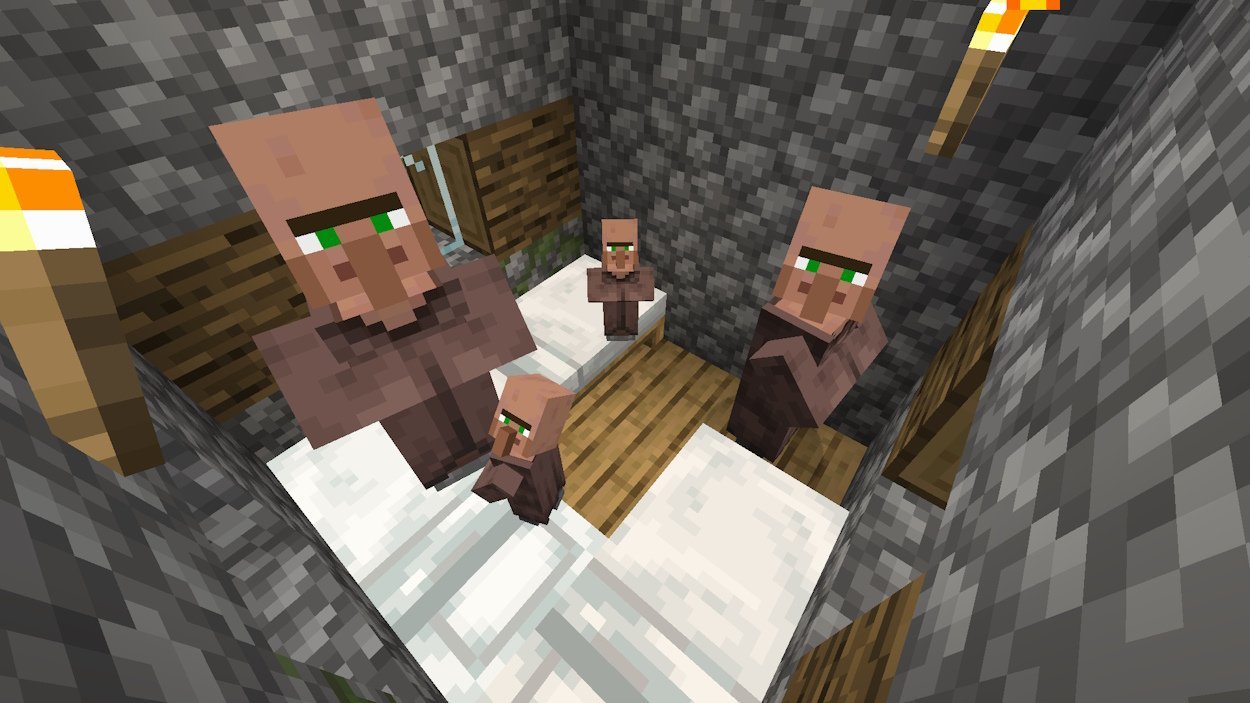
Villagers do not breed like other mobs. There is no single love-mode food and no heart particles on demand — instead, breeding is a small checklist of housing and groceries, and if any item on it is missing, nothing happens and the game will not tell you why. Once you understand the three requirements, though, you can grow a two-villager starter pair into a full trading hall population.
The Three Requirements
- Two adult villagers — any professions work, including nitwits; unemployed is fine too.
- More beds than villagers — every villager, including the baby about to be born, needs an unclaimed bed, with at least two empty blocks of space above it so the baby can bounce on it.
- Enough food — each villager needs food worth 12 points in its inventory: bread is worth 4 points, while carrots, potatoes and beetroots are worth 1 each.
Doors are not required anymore — that rule died with the Village & Pillage update. A bed is crafted from three wool over three planks, so a sheep or two covers your housing costs.
Step by Step
First, get two villagers into an enclosed, well-lit space. Villagers will not follow you, so the standard tricks are pushing them, placing a boat in front of them and rowing them home, or running a minecart track between the village and your breeder. Second, place at least three beds in or near the enclosure — one per adult, plus a spare for the baby. Third, throw the food on the ground in front of them. Provided mob griefing is enabled in your world, they will pick it up, and villagers holding extra food will share it by tossing it to each other, so you do not need to portion it out precisely. Then just wait: villagers breed during their gather time in the morning and evening, hearts appear, and a baby villager shows up. The baby takes 20 minutes to grow into an adult, and the parents have a 5-minute cooldown before they can try again.
A Farmer Makes It Automatic
The manual version gets tedious fast. The classic automation is to put a farmer villager next to a carrot or potato crop: farmers harvest and replant crops on their own, stuff their inventory with food, and share the surplus with nearby villagers. Add a row of extra beds and the enclosure grows itself while you are off doing other things. That same principle, with babies separated through a one-block gap or a water stream, becomes the infinite villager breeder designs that feed most trading halls.
Why Your Villagers Will Not Breed
Work through this list in order — one of these is almost always the culprit. Not enough beds: population is hard-capped by bed count, so three beds and three villagers means breeding stops. Not enough food: one carrot each does nothing; they need 12 points each. mobGriefing is off: if that gamerule is set to false, villagers cannot pick up food at all — set it back to true. Ceiling too low: beds need two blocks of air above them. Cooldown: wait five minutes after the last baby. Timing: they only breed around their morning and evening gather periods, not during work hours. And keep the area lit and fenced — a single zombie wandering in will shut the whole operation down.
Frequently asked questions
How much food do villagers need to breed?
Each villager needs 12 food points: 3 bread (4 points each), or 12 carrots, 12 potatoes or 12 beetroots (1 point each). Throw the food near them and they will pick it up.
Why won't my villagers breed even with food?
The usual causes are not enough unclaimed beds, ceilings less than two blocks above the beds, the mobGriefing gamerule being off, or the 5-minute cooldown. Population can never exceed the number of beds.
How long does a baby villager take to grow up?
Twenty minutes of real time. After growing up, the new villager can take a profession from any unclaimed job site block you place nearby.
Do villagers need doors to breed?
No. Doors were required in very old versions, but since the Village & Pillage update only beds and food matter.
More Minecraft guides
 Minecraft Brewing Guide: All Potion RecipesUpdated 12 November 2026
 Minecraft Raids Explained: Bad Omen, Waves and Hero of the VillageUpdated 12 November 2026
 All Minecraft Villager Jobs ExplainedUpdated 12 November 2026
 Woodland Mansion in Minecraft: How to Find and Loot OneUpdated 12 November 2026
 Redstone Components in Minecraft: A Complete GuideUpdated 12 November 2026