Home › GTA › GTA 6 Wanted System Explained: Six Stars, Police Memory and Hot Areas
GTA 6 Wanted System Explained: Six Stars, Police Memory and Hot Areas
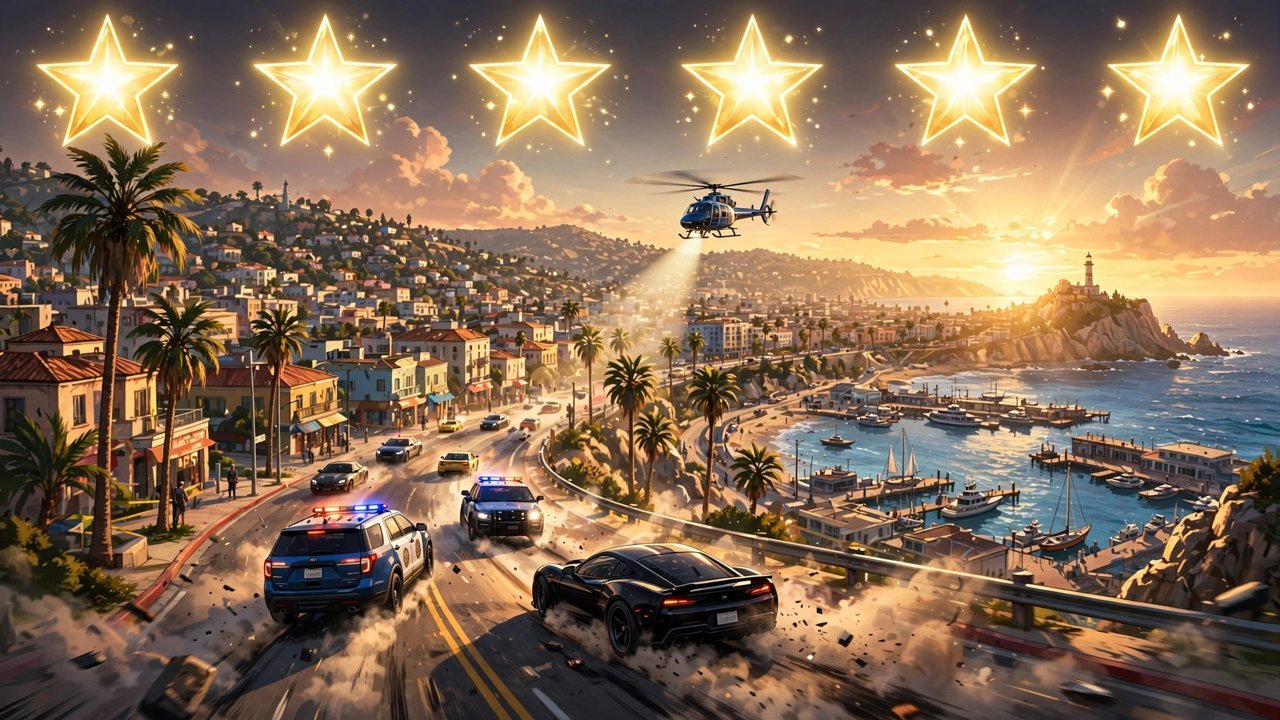
The wanted system is the engine of every GTA game, and for GTA 6 Rockstar has rebuilt it around a simple idea: the police can only chase what they actually know. The stars are back up to six, but what they mean — and how you get rid of them — has changed more than in any previous game.
Six Stars Are Back
GTA 6 returns to a six-star maximum, the first time since Chinatown Wars in 2009; GTA 5 topped out at five. The number still reflects how serious the response is, but in GTA 6 a crime does not alert the police by itself. Someone has to witness it, or an alarm or vehicle tracker has to report it. Brandish a weapon and let your targets run, and the report that reaches dispatch may be vague enough to keep the response small. Escalate into violence, and both the information and the response grow.
What the Star Icons Mean
| Star state | Meaning |
|---|---|
| Hollow | A crime has been reported but police have no description of who did it. Officers head to the scene to investigate; leave before they arrive and nobody is hunting you personally. |
| Solid white | Police have identified you and are pursuing with line of sight. |
| Flashing white | You have broken line of sight. Police are searching your last known position. |
| Red | You have escaped the pursuit, but the crime scene remains an active hot area where police keep your description. Return matching it and the chase restarts. At six stars, the hot area covers the whole map. |
The Dispatch Checklist Under Your Stars
Beneath the stars sits a row of icons — effectively the police's live report on you. Each icon is one fact they hold, and each can be taken away:
- Weapon — a weapon was seen during the crime.
- Person — police have a physical description of the suspect.
- Clothing — police know what the suspect is wearing.
- Duo — police know two people committed the crime and are looking for Jason and Lucia together.
- CCTV — security camera footage has captured the suspect.
- Vehicle — police know the car the suspect used.
As Rockstar North's Rob Nelson puts it, officers can know what a character looks like, what they are wearing, which vehicle they are in and whether the pair are together. Your escape strategy is to strip that list down.
Regional Heat: Crime Scenes Remember You
Heat belongs to places now, not just to you. An area where you committed a crime stays marked as a hot area after the chase ends, with police holding your details there. Walking back in while still matching their description can reignite the pursuit, so sometimes the correct move is simply to stay away and let the area cool down — a memory earlier games lacked, where escaping the chase erased everything instantly.
How to Lower Your Wanted Level
- Change your clothes — swapping outfits removes the clothing detail, and Jason and Lucia can keep spare clothes in the car trunk precisely for this.
- Change your appearance — hats, glasses, bandanas and hairstyles alter the physical description; wearing a mask during a crime limits what witnesses can report in the first place.
- Ditch the vehicle — abandoning or destroying a known car removes the vehicle detail. Beware high-end cars with GPS trackers: they broadcast your position unless you keep moving fast, abandon the car, or visit a specialist fence with a signal blocker.
- Split up — if police are hunting a duo, separating Jason and Lucia removes that fact and drops the pressure on both.
- Stay quiet — crimes nobody witnesses generate little heat. Intimidation that ends without violence produces a far smaller response than a shootout.
A Smarter Pursuit
The chase itself has changed too. Police cars are no longer permanently marked on your minimap with vision cones; you read the pursuit by line of sight, helped by a Focus mode — similar to Eagle Eye in Red Dead Redemption 2 — that highlights nearby officers. Nelson has said that at three stars or more in the city, out-driving police in an ordinary car is nearly impossible: the intended escape is a fast car or bike, or ditching the vehicle and cutting through alleys on foot. Officers coordinate by radio, set near-invisible stinger strips across roads at night, and use K9 units that will run you down. Get caught and it is the classic Busted screen and a respawn.
The Criminal Profile Sits Behind It All
Separate from any single chase, GTA 6 tracks a long-term Criminal Profile based on how you behave — a yellow X on the HUD marks enemies you incapacitate rather than kill, so you can choose your level of violence deliberately. Needless escalation has lasting consequences: witnesses call the police faster, armed citizens fight back harder, and rival gangs may attack on sight. The wanted system handles the crime in front of you; the profile remembers the criminal you are becoming.
Frequently asked questions
How many wanted stars are in GTA 6?
Six. That is one more than GTA 5 and the first six-star system since GTA: Chinatown Wars in 2009.
What does a hollow star mean in GTA 6?
A crime has been reported but the police have no description of the person responsible. They will investigate the scene; if you are gone before they arrive and they never identify you, there is no personal pursuit.
How do you lose the police in GTA 6?
By removing what they know: change clothes (spares live in the car trunk), alter your appearance, ditch or destroy a known vehicle, split Jason and Lucia up, and avoid the hot area until it cools. Simply driving away is no longer enough at higher levels.
Can police recognise your car in GTA 6?
Yes. If a camera or officer spots the vehicle, a vehicle icon joins the police's checklist. Tracked high-end cars also broadcast your location until you abandon them or visit a fence with a signal blocker.
More GTA guides
 How to Do Heists in GTA Online: Requirements and How to StartUpdated 12 November 2026
 How to Make Money in GTA 5 Story Mode: The Best MethodsUpdated 12 November 2026
 How to Make Money Fast in GTA Online: The Best Methods RankedUpdated 12 November 2026
 How to Sell Property in GTA Online: Trade-Ins ExplainedUpdated 12 November 2026
 How to Switch Characters in GTA 5 on PC, PlayStation and XboxUpdated 12 November 2026