Home › Puzzle Games › Best Wordle Starting Words: Strong Openers and Why They Work
Best Wordle Starting Words: Strong Openers and Why They Work
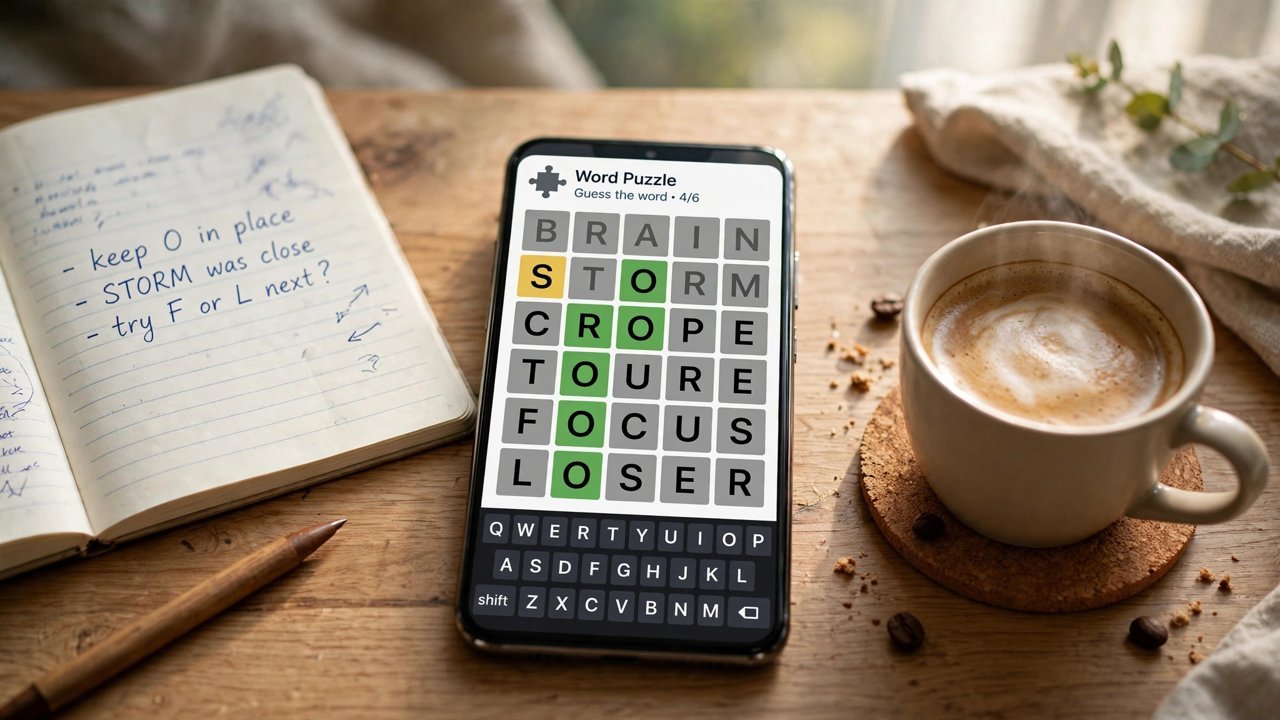
Every Wordle game is won or lost on information, and no guess carries more of it than the first one. A strong opener can confirm two vowels and a common consonant before you have committed to anything; a weak one can burn a turn on letters the answer was never likely to contain. Nothing here will hand you the answer — Wordle does not work that way — but these are the starting words that consistently give players the best raw material to work with, and the reasoning behind them.
The Three Rules of a Good Opener
- Five different letters. Every repeated letter is a wasted test. Words like ARENA spend two slots on A and tell you half as much.
- Vowels early. Almost every English word contains at least one vowel, and most contain two. Clearing A, E, I, O and U quickly shrinks the field dramatically.
- Common consonants. Prioritise the letters that actually show up in five-letter words — S, T, R, N and L — over rare ones like J, Q, X and Z.
Strong Starting Words Worth Using
These openers tick all three boxes and are favourites among regular players:
- ARISE — three vowels plus S and R, two of the hardest-working consonants in the game.
- SLATE — no wasted letters, and it tests the S-T pairing that ends and begins so many answers.
- CRANE — balanced, common letters in natural positions.
- RAISE — like ARISE, a vowel-heavy probe with S in a useful spot.
- AISLE, AUDIO, ABOUT, RATIO, MEDIA and IDEAL — all fine alternatives if you like rotating openers.
The Three-Word Opening Sequence
Plenty of players ignore whatever the first guess returns and fire off two more fixed probes. The classic combination is SALTY, DINER, POUCH. Between them they test fifteen completely different letters, including all five vowels, so by guess four you usually know the answer's entire alphabet and are simply arranging it. The trade-off is real — you spend half your board on probes and can almost never score a flashy two-guess win — but for protecting a long streak, few approaches are as reliable.
What the Experts and the Algorithms Say
The starting-word question has been studied properly. Researchers at MIT ran the game through an exact solver and published a peer-reviewed paper concluding that SALET — an obscure word for a 15th-century helmet — is mathematically the optimal first guess. The NYT's own WordleBot favours SLATE in normal mode and LEAST in hard mode, where you are forced to reuse confirmed letters. And an information-theory analysis by programmer Grant Sanderson, which measured which opener destroys the most uncertainty on average, landed on CRANE. The three answers differ because the methods differ, but notice that all of them are built from the same small pool of common letters.
The Letter-Frequency Shortcut
If you prefer to improvise, aim your guesses at the letters English uses most. One analysis of 172,000 words put E at the top with an 11.51% frequency, followed by S at 9.52% and I at 9.01%:
| Most frequent letters | E | S | I | T | A | O | N | H | R | D | L | C |
|---|
Whichever opener you settle on, treat it as an information-gathering tool rather than a lucky charm. The win comes from what you do with the colours it gives back.
Frequently asked questions
What is the single best starting word in Wordle?
There is no universal answer because it depends on how you measure it. An MIT study found SALET optimal, WordleBot prefers SLATE, and information-theory analysis points to CRANE. All are excellent; pick one and learn how its results play out.
What are the best three starting words to use together?
SALTY, DINER and POUCH are a popular fixed trio. They contain 15 different letters between them, including all five vowels, which leaves you arranging known letters rather than hunting for new ones.
Should I use the same starting word every day?
Many streak-conscious players do, because it makes your second-guess decisions faster and more consistent. Rotating openers is more varied but less predictable. Either works if the word itself is strong.
Is SALET really a word?
Yes. A salet is a type of helmet worn in the 15th century. It is a legal Wordle guess, and an MIT study identified it as the mathematically optimal opener, even if almost nobody uses it in casual play.
More puzzle game guides
 How to Reset Your Wordle Streak and Stats on iPhone and AndroidUpdated 12 November 2026
 Past Wordle Answers: How to Check Every Previous WordUpdated 12 November 2026
 What Is Quordle? Wordle's Four-Word Challenge ExplainedUpdated 12 November 2026
 What Is Wordle? The Daily Word Game ExplainedUpdated 12 November 2026
 Wordle Tips and Tricks: 8 Habits That Win More GamesUpdated 12 November 2026