Home › Minecraft › How to Make TNT in Minecraft
How to Make TNT in Minecraft
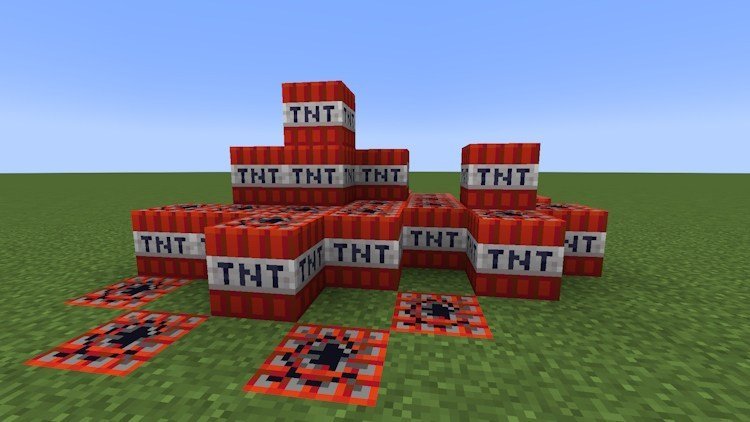
TNT is Minecraft's controlled explosion in a block: a mining shortcut, a trap, a prank and occasionally a landscaping tool. It is not cheap to make, and it does not forgive carelessness, so it pays to understand the recipe, the ways to get it for free, and exactly how to set it off from a safe distance.
TNT at a Glance
- Blast power: 4 — the same as a standard creeper explosion
- Found naturally: desert temples and woodland mansions
- Underwater: destroys no blocks at all (but still hurts mobs and players)
- Dropped items caught in the blast: destroyed, like items in lava
The TNT Crafting Recipe
One TNT block takes five gunpowder and four sand (red sand works identically). On a crafting table:
- Place the five gunpowder in an X shape — the four corners and the center of the grid.
- Fill the four remaining edge slots with sand.
- Take the TNT from the result slot.
Gunpowder is the bottleneck ingredient. Creepers, ghasts and witches each drop 0–2 of it, and a dedicated creeper farm can produce thousands per hour once built. Sand is the opposite problem: deserts and beaches offer effectively unlimited amounts, and red sand blankets the badlands. Collect both in bulk before you start crafting in bulk.
Free TNT: Where It Generates Naturally
The famous source is the desert temple. Beneath the terracotta pattern in the main chamber is a hidden treasure room — and a stone pressure plate wired to nine TNT blocks under the floor. Break the plate or dig in from the side wall, and all nine blocks are yours, tool-free. Woodland mansions hide a fake End portal room built with TNT as well. You will also find loose TNT in loot chests in desert temples, shipwrecks and buried treasure. Any placed TNT can simply be punched to pick it back up, as long as it has not been lit.
How to Set Off TNT Safely
- Redstone: power the block or the block next to it with a lever, button or redstone line — the classic stand-back method
- Fire: flint and steel or a fire charge used on the block lights it; spreading fire and nearby lava can do it accidentally
- Flaming projectiles: a Flame-enchanted bow, or any arrow that passes through lava or fire, primes TNT from range
- Other explosions: a nearby detonation — another TNT, a creeper, an End crystal — chains it instantly
- Dispensers: a dispenser that places TNT primes it automatically as it places it
Once primed, TNT becomes an entity: it flashes, falls if unsupported, and explodes after roughly four seconds. You cannot punch it out or pick it back up, so commit before you light. Primed TNT drops the blocks it destroys as items — unlike a creeper blast, which deletes a share of them — but any loose items caught in the explosion itself are destroyed.
Blast Resistance: What Survives a TNT Blast
| Block | Blast Resistance |
|---|---|
| Dirt, grass, sand | 0.5 |
| Wood, bone block | 2 |
| Cobblestone, stone, bricks, nether bricks | 6 |
| End stone | 9 |
| Water and lava | 100 |
| Obsidian | 1200 |
| Bedrock | 3,600,000 |
In practice, a TNT blast tears a rough crater about two to five blocks deep in soft ground, bounces off anything stone-tier or better, and does nothing at all to obsidian — which is why obsidian lining is the standard way to build a blast chamber. Submerged TNT is the odd case: it still damages creatures, but the water absorbs the block damage completely, so it is safe to use around builds you want to keep.
Frequently asked questions
What is the TNT recipe in Minecraft?
Five gunpowder arranged in an X (four corners plus the center of the crafting grid) and four sand or red sand filling the edge slots. That makes a single TNT block, so gunpowder farming is essential for bulk use.
Does TNT destroy dropped items?
Yes. Loose item entities caught in a TNT explosion are deleted, the same as items burned in lava. Blocks destroyed by the blast do drop as items, but collect them from a safe distance.
Does TNT work underwater in Minecraft?
Only partly. Underwater TNT damages mobs and players but destroys no blocks whatsoever, which makes it safe for clearing creatures near builds you want to protect.
Is TNT affected by gravity?
Not while it sits unlit — it behaves like a normal solid block. Once primed, it turns into a falling entity, drops if there is nothing beneath it, and then explodes.
More Minecraft guides
 How to Get Gunpowder in MinecraftUpdated 12 November 2026
 How to Tame a Parrot in MinecraftUpdated 12 November 2026
 How to Make an Iron Farm in MinecraftUpdated 12 November 2026
 Piglin Bartering in Minecraft: How to Trade with PiglinsUpdated 12 November 2026
 Minecraft Brewing Guide: All Potion RecipesUpdated 12 November 2026