Home › Minecraft › Best Uses of the Crafter in Minecraft
Best Uses of the Crafter in Minecraft
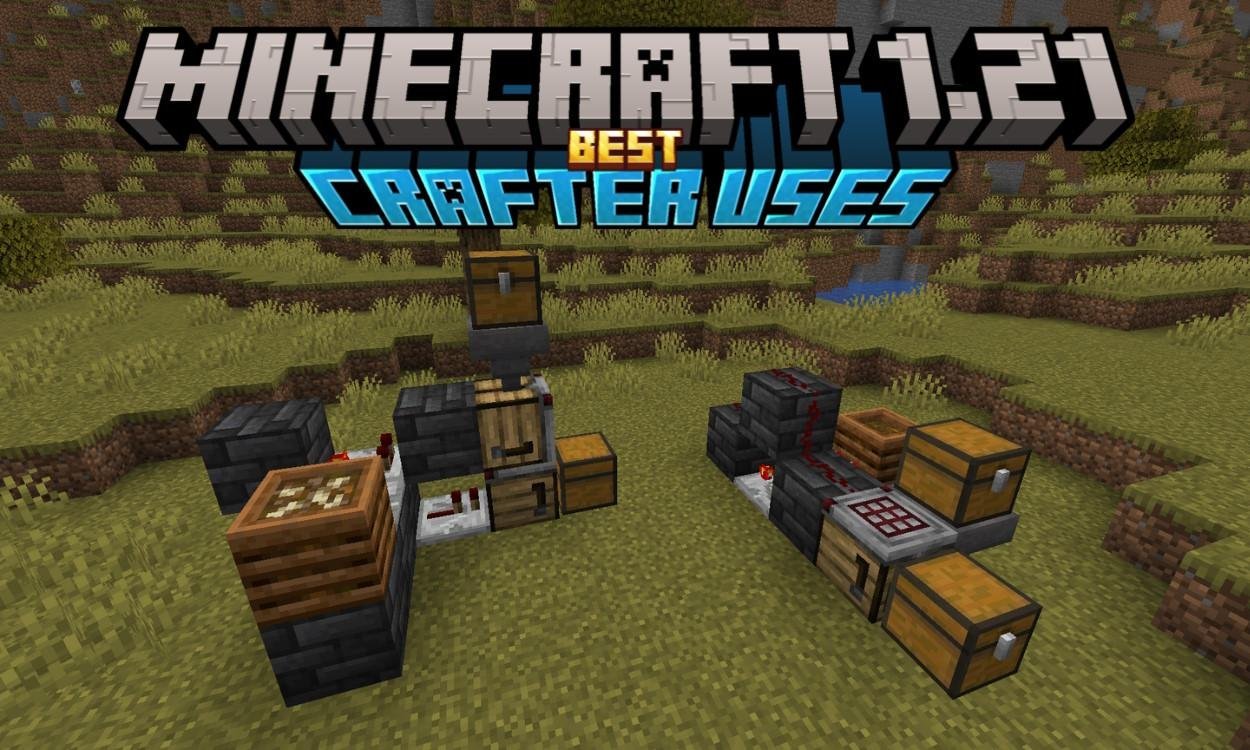
Crafting has always been the one job Minecraft made you do by hand. The crafter changes that. It looks like a crafting table with a face, but feed its grid with items, give it a redstone pulse, and it produces the finished recipe on its own, ready for hoppers to carry away. Slots you do not need can be toggled off so ingredients only land where the recipe wants them. Once you start thinking of it as a machine rather than a block, the possibilities stack up quickly.
1. A General-Purpose Auto-Crafter for Simple Recipes
Most recipes in Minecraft are simple: one or two ingredients, no complicated shapes. Compact community designs, including a well-known build by RaysWorks, exploit that beautifully. You disable the grid slots the recipe does not use, fill an input barrel with ingredients, and the machine pulses out finished items one after another. Armor pieces, building blocks, buckets, shears, minecarts, boats — a single small contraption can cover a surprising share of everything a base regularly needs, and it only asks for a handful of redstone components in return.
2. The Self-Feeding Dried Kelp Block Loop
Dried kelp blocks are among the best furnace fuels in the game, and the crafter turns them into a closed loop. One popular tileable design, created by xisumavoid, works like this: dried kelp feeds into the crafter until the ninth piece fills the grid, at which point the redstone signal grows strong enough to trigger a craft. The finished kelp blocks are funnelled into smokers, which dry more kelp to keep the cycle going, and any overflow lands in a chest as spare fuel. Build one module or tile ten of them side by side; the system scales with your appetite for smelting.
3. Bamboo In, Planks Out, Forever
Bamboo grows absurdly fast, which makes it the perfect raw material for an unattended wood supply. A two-crafter chain popularised by Mumbo Jumbo does the whole conversion: the first crafter compresses bamboo into blocks of bamboo, the second turns those blocks into planks and drops them into storage. From there the planks can feed yet another crafter making sticks, chests or tools. It is a fully hands-free timber pipeline powered by the fastest-growing plant in the game.
4. Bulk Compacting and Storage Jobs
Beyond the showcase machines, the crafter shines at the boring jobs nobody enjoys doing by hand. Compressing ingots and nuggets into storage blocks, turning harvests into their compact forms, breaking bulk ingredients down again on demand — any recipe you repeat a hundred times is a recipe the crafter should be doing instead. Hook one to the output of a farm and the produce arrives pre-processed, neatly stacked and ready to use.
Getting Started
If you are new to the block, begin with the kelp or bamboo designs rather than the general-purpose machine. Both are small, forgiving, and they teach the two lessons every crafter build relies on: control which slots ingredients can enter, and let a comparator or clock decide when to pulse. Master those, and automated crafting stops being an endgame luxury and becomes just another utility your base provides.
Frequently asked questions
How does the crafter decide when to craft?
It crafts once each time it receives a redstone pulse, using whatever is currently in its grid. Most machines use a comparator watching the grid fill up, or a simple clock, to decide when to fire that pulse.
What do the disabled slots in a crafter do?
Clicking a slot toggles it off, which stops hoppers and other automation from placing items there. That is how you force ingredients into only the squares a recipe needs, so a three-ingredient recipe does not get clogged with items in the wrong positions.
Can crafters feed into each other?
Yes, and chaining them is one of their best uses. The bamboo design, for example, uses one crafter to make blocks of bamboo and a second to turn those blocks into planks, creating a fully automatic conversion line.
What is the best first crafter machine to build?
A dried kelp block loop or a bamboo-to-planks chain. Both are compact, tileable, and produce something genuinely useful (fuel or wood) while teaching you how slot control and redstone timing work.
More Minecraft guides
 What Do Horses Eat in Minecraft? Every Food and Its EffectsUpdated 12 November 2026
 When Did Minecraft Come Out? Full Release TimelineUpdated 12 November 2026
 6 Best Uses of Wind Charge in MinecraftUpdated 12 November 2026
 6 Best Uses of Wither Roses in MinecraftUpdated 12 November 2026
 All Wolf Variants in Minecraft and Where to Find ThemUpdated 12 November 2026